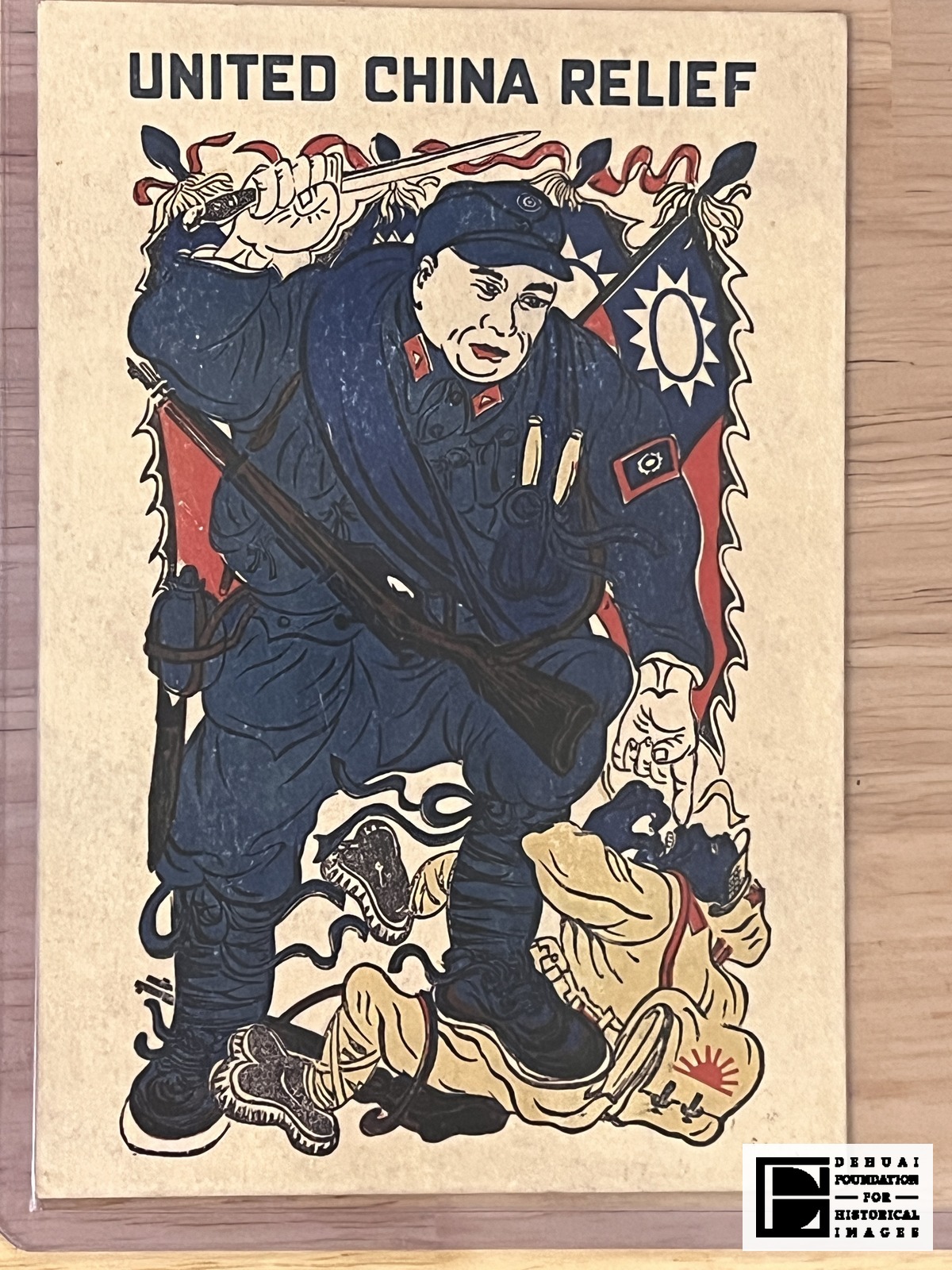
"UNITED CHINA RELIEF": an armed soldier standing over a fallen soldier and a form marked with a rising sun
A soldier fills the sheet, drawn head-on and slightly crouched, in a dark indigo padded uniform with a peaked field cap, red collar patches, a bandolier and haversack across the chest, two…
The objectphotographed as held, uncropped
Catalogue description
A soldier fills the sheet, drawn head-on and slightly crouched, in a dark indigo padded uniform with a peaked field cap, red collar patches, a bandolier and haversack across the chest, two pale cylinders tucked into the breast, and a rifle slung diagonally across the body. His right hand is raised above his head holding a straight sword; his left arm is thrust down and forward, index finger extended, over the figure at his feet. The patch on his left sleeve — a red-bordered rectangle on a dark ground — carries a small white rayed sun, and a large white rayed sun stands on the blue field spread behind his shoulder. A second, smaller white rayed sun on blue appears at the upper left, partly hidden behind his cap and a tasselled pole; whether these are two banners or one field broken by the figure cannot be told from the drawing. The cap badge is not that emblem: at full resolution it is a small pale roundel of concentric rings, with no rays. Around the upper edge, spear points, tasselled poles and red pennants rise behind him.
Beneath his boot lies a second figure, sprawled on his back in pale buff with a red belt, puttees and studded boot soles turned toward the viewer, his head thrown back at the right edge. Beside him is a rounded pale form — a pack, a helmet or a cap; which cannot be told from the drawing — marked with a red rising sun. That emblem and the buff uniform are the only grounds on the object for reading this figure as Japanese; nothing printed on the sheet names him.
The blue fields behind the standing figure show red only as wedges at their ragged drawn edges, so the flags are not identifiable from the drawing: a white rayed sun centred on blue is the Kuomintang party pattern, while the national flag of the Republic of China carries that sun in an upper-hoist canton on a red field, and the red areas elsewhere on the sheet may be separate pennants. The composition reads to this archive as the vocabulary of the menshen or door-god print — the frontal stance, the raised weapon, the flat outlined colour, the banners and spear points rising behind the shoulders, the enemy trodden underfoot. That is the archive's reading of a pictorial convention; nothing printed on the object claims it, and no published source connecting this design to that tradition was found.
The three words across the top are the whole of the sheet's text. There is no appeal, no sum, no address, and no line identifying who the figure is, what he is standing on, or who printed the sheet. Apart from the organisation's name, nothing on the sheet refers to a campaign, a fund or a place. One other United China Relief poster was located and read for this record — Baldridge's "China carries on" at the Library of Congress — and it pairs a soldier with a child and a shrouded body; this sheet shows no civilians at all. Both figures on this sheet are drawn in the same heavy stylised idiom, the standing one with an individuated face and the fallen one with his features turned away at the edge of the design; the archive does not treat either drawing as neutral, and cannot establish whose hand made them.
Transcriptiontext on the object, as printed
UNITED CHINA RELIEF

[This is the whole of the text on the face of the sheet. Full-resolution crops of the title line, all four margins, both bottom corners and the left and right edges show no Chinese or Japanese characters, no slogan or caption, no artist signature or seal, no printer's or publisher's imprint, no series, stock or plate number, no stamps or cancellations, and no pencil or ink annotation. The sun devices in the image — the rayed suns on the blue fields, the small rayed device on the sleeve patch, and the red rising sun at the lower right — are graphic devices containing no characters. The brown specks in the lower right margin are not writing. The verso was not photographed.]
Historical context
United China Relief was founded in New York in 1941 as an umbrella for several existing American agencies working in China — among them the American Bureau for Medical Aid to China, the China Emergency Relief Committee, the American Committee for Chinese War Orphans, the Church Committee for China Relief, the American Committee for Chinese Industrial Cooperatives and the China Aid Council — with a board that included Pearl Buck, Henry Luce, Wendell Willkie, John D. Rockefeller III, David O. Selznick and Thomas Lamont, and Eleanor Roosevelt as honorary chairman. Its opening target was five million dollars, and it raised over fifty million dollars over ten years. It was a member agency of the National War Fund, the federated wartime charity established in February 1943, which ended at the start of 1947 and was formally liquidated in April 1948; the Library of Congress record for Baldridge's "China carries on" quotes that poster's caption as "United China Relief, member agency of the National War Fund." After the Second World War the organisation was renamed United Service to China; the year of the rename is not established here. Menshen — door gods — are paired guardian figures of Chinese folk religion whose names or images are attached to the leaves of a door and renewed at the New Year. Sacrifice to a door spirit appears in the Book of Rites; by the Han dynasty that spirit had become the two gods Shenshu and Yulü, whose names or images were painted on peachwood and fixed to doors, and the Tang generals Qin Shubao and Yuchi Gong became the popular door-god figures later. The composition of a Chinese soldier standing on a sprawled Japanese one was in circulation in the same years: the Library of Congress holds a 1945 poster in its Office of War Information collection, catalogued as a cartoon of a Chinese infantryman, complete with arms, stomping on a Japanese soldier sprawled at the bottom of the picture, carrying a New Year greeting, with text in both Chinese and English and filed in the United States series. It is a different object from this sheet — 36 x 20 cm, dated 1945 — and is cited here only as a parallel, never as an identification.
What is not known
- The artist is unidentified. No signature, monogram, printer's imprint, copyright line, union label or stock number appears on the face of the sheet, and no matching design was found in the Library of Congress, UNT Digital Library, Hoover Institution or Imperial War Museums poster records searched by the drafter, nor in a further search made for this final record.
- No date is printed on the object and the date of this printing is not established. 1941 is used as an ordering key because it is the founding year of the organisation named on the sheet, not because the sheet is dated to it.
- Nothing establishes that this is a period object rather than a later reproduction, a private or artist's print, or a design never issued by United China Relief. The sheet carries no printer's imprint, no union label and no copyright line — unusual for a 1940s American mass-campaign poster — its condition is bright, and no match was found in four institutional poster collections. The archive neither asserts nor denies a period printing.
- That United China Relief issued this sheet is not established. The organisation's name is printed on it; that identifies the body being named, not the body that commissioned, paid for or printed the design.
- Whether the sheet was printed in the United States or in China is not established, and no place of printing appears on it. The geo coordinate given is the city where the named organisation was based, not a location for the object.
- The sheet's dimensions are not known and nothing in the photograph establishes scale. It was not measured. 'Poster' is assigned from the format and the display lettering; the object could equally be a smaller broadside or a window card.
- The printing process is not established; the flat colours and heavy outline are consistent with a relief cut, with a lithograph reproducing a cut design, and with a photomechanical reproduction of either. Whether the display lettering is drawn, stencilled or set in type cannot be determined from the photograph. The paper's fibre structure cannot be judged from a photograph, and whether the object is a single sheet, a card, or a sheet mounted on board cannot be told, because the dark band at the lower edge of the photograph is the board it lies on.
- The verso was not photographed, so any pencil notes, stamps, dealer marks, blind stamp or printer's imprint on the back are unrecorded.
- The fallen figure is read as Japanese from the red rising sun on the rounded form beside him and from his buff uniform only. The object carries no caption naming him. Whether that rounded form is a pack, a helmet or a cap, and whether it belongs to him at all, cannot be told from the drawing.
- The blue fields behind the standing figure carry two white rayed suns and are not identifiable: a white rayed sun centred on a blue field is the Kuomintang party pattern, while the national flag of the Republic of China places the sun in an upper-hoist canton on a red field. Red appears only as wedges at the ragged drawn edges of the blue, the red areas elsewhere on the sheet may be separate pennants, and whether the two suns belong to two banners or to one field broken by the figure cannot be told from the drawing.
- The cap badge is a small pale roundel of concentric rings and is not identified; it is not the rayed sun that appears on the sleeve patch and the blue fields.
- The door-god (menshen) reading is the archive's reading of a pictorial convention. Nothing printed on the object claims it, and no published source connecting this particular design to that tradition was found. An earlier draft of this record additionally derived door-god prints from the painted stage general of Chinese opera; that derivation is unsourced and has been removed.
- The year in which United China Relief was renamed United Service to China is not established here; no source read for this record gives it, and the Princeton finding aid that would settle it could not be read (it returns a bot-detection page).
- The month of United China Relief's founding is not established here; the sources read for this record do not agree on it, so only the year is stated.
- Only one other United China Relief poster — the Baldridge sheet at the Library of Congress — was actually read for this record; a second appeared in search results but its catalogue record was not fetched, so nothing about it is stated here.
- Provenance is not established: how and when the sheet entered the collection is unrecorded here.
TFA-CA-124, “"UNITED CHINA RELIEF": an armed soldier standing over a fallen soldier and a form marked with a rising sun,” Undated. The name printed on the sheet gives only a terminus post quem: United China Relief was founded in 1941. The date of this printing is not established.. Picturing Chinese America — Tarita Foundation Archive, 2026. Accessed [date].